
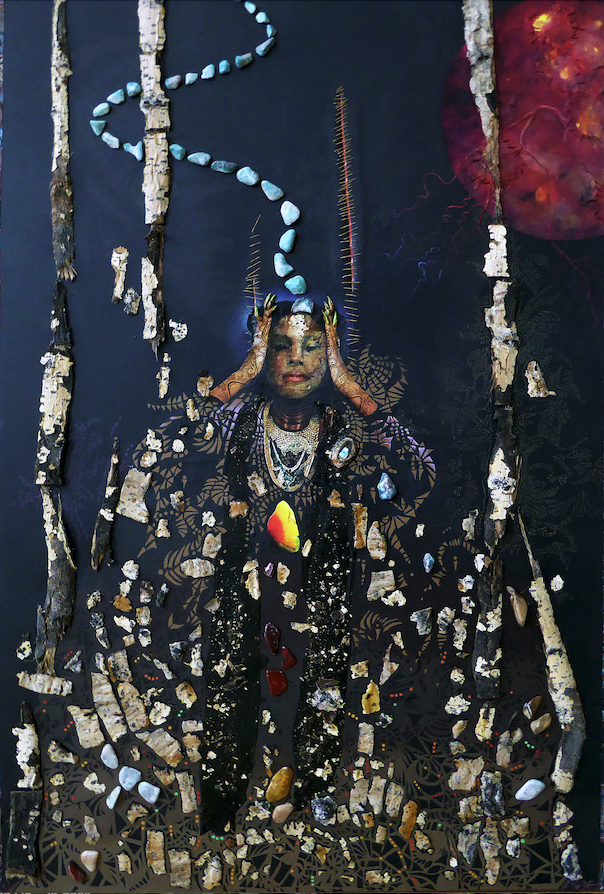
Imagic—the image is the heart of magic which is made by imagination—what we see in the mind’s eye makes magic—makes us magic—the image—who casts the net—the magenet—magic magnet—net of subtle power dipping into the life-stream—glowing in the dark—a web that surrounds the earth Her body—magnetic field—imagentic—how we are attracted to magic—it draws us in—we are fish caught in a magic net—imagenitic—because our genes remember, our cells remember, the source, the origin, the beginning—imagenesis—creation out of image—creation of the image—from the image all is born—all is magic—imagnosis—this, through what we imagine we know. --Starhawk (1979/89, p. 122)
Ludic Transmission, mixed media, 2017
by R.M. Fisher & B. Bickel
Part of a collaborative project Heart of the Mountain a nature, arts and trance-based intervention into a medical crisis.
A spiraling visionary wordplay on art-magic and image from the eco-spiritual feminist peace activist Starhawk, written in 1979 opens this post. What a delight to see a thinking storm of ideas and images and their role in knowledge (i.e., imagnosis) and (i)magic making.
This post updates you on our recent move of Studio M* and reflects on and weaves together thematics of art-magic, art-cure and art-care. Art-cure has come to our attention specifically, through a book drawing upon the scientific findings of many researchers by Fancourt (2026); in addition, we enjoyed revisiting the ideas of Kenneth Beittel, Starhawk, and James Hillman, alongside our own discoveries of late.
In April 2026, Studio M* entered a new collaboration with My Inner Harbour, an inner-city wellness centre, in Nanaimo, BC, Canada. We are now located in the upstairs Artist Suite along with three other artists, while a membership-based wellness center is run by Jessica on the main floor of this heritage house. Studio M*’s in-person and online programming for fall 2026 will overlap with the wellness center programming and where possible continue to encourage and support artists of all kinds to gather and offer gifts of art-making and art itself. As well, we are especially excited about the arrival of our first Nanaimo Artist-in Residence with Hallie Sanclemente Morrison, a first-generation Colombian-American interdisciplinary a/r/tographer, curator, and community organizer who is decolonizing their ways of being.
In 2018, one of our first blogs featured “Art, Care & Healing”, in which we cited an article from a Canadian art magazine that foregrounded how important art(s) are for care and healing in our communities (see also our discussion of this magazine article on p. 3 of Bickel & Fisher, 2023). Since our study of Spontaneous Creation-Making (SCM) during the COVID-19 shutdown, we coined “art-care” as a means to create a necessary link between caring and arting generally, in which the co-building of community was a significant outcome of sharing artworking online in a time of crisis. And, indeed the world surely needs a lot more of this kind of artworking/playing to be going on as troublesome times wear many of us down. We continue to experience how the arts have a role in health, sanity and sustainability. Even our local paper “Nanaimo News Bulletin” had a July article heading that read,“Public art in Nanaimo Helps Reduce Vandalism and Other Crimes.” We believe it does far more than that, but it is great to see art being recognized for its service to community wellbeing.
Daisy Fancourt’s (2026) book Art Cure, confirms and validates, and further informs our understanding of the importance of the arts and caring/health for individuals and the collective. Sometimes, it is good to read the compiled scientific evidence that shows correlation and cause of how beneficial arts engagement is, in general and as well as, in more intimate art-making.
We share a selection of quotes from her book:
Maybe from the ground up, we as a collective can help our societies embrace the arts, culture, and creativity and realize the remarkable impact they have. For sickness. For health. For all.” (p. 244)”
“Imagine if we invested in arts and cultural venues and libraries in every community….It’s a surefire way to improve societal well-being.” (p. 240).
“What if we stopped trying to push the idea that success in the arts means fame, and instead invest properly in artists, providing more opportunities for people to lead community programs so everyone could engage in the arts more?” (p. 241)
Fancourt also discusses the emergence of a preventative and healing notion of “social prescription” by the more progressive agents of psychological and medical communities. This prescription, often replacing medical and pharmacological treatments, offers access for people (e.g., patients) to engage arts locally, to help their restoration and/or act as cures, including the cure of isolation that so often happens when one is disabled by an illness.
Though art cure knowledge is important, there is much more going on with what we call ‘art-care.’ We return for an artist-researcher-philosopher’s perspective on the transforming power of art to Ken Beittel and his opus book A Celebration of Art & Consciousness, 1991:
“Art operates as a form of intimate knowledge.” [p. xi]
“The artist and the poet have privileged access to the creating stream of consciousness, to how the eye and hand, the mind and spirit, the medium and the image, confound and comfort one another in the process of creating.” [p. xiii]
“Art is presented as an unfolding through a hidden order, the exemplifying dialogue, and as play transforms into structure.” [p. xiv]
In complement to the scientific discourse on art and healing, Beittel teaches that the arts can ‘save the world’ perhaps, but aesthetics and arts also help to mediate how we evolve personally and collectively as human beings. Beittel’s ideas are connected to further deepening of a spiritual and more-than-human relational sensitivity within an ethical and beautiful way of being. Fancourt’s book misses the importance of ‘beauty’ and ‘spirituality’ in and of itself as part of nature and creation.
With less emphasis on self-improvement as Fancourt’s art-cure is, art-care helps people to develop within community, as part of spiritual care and health overall, leading towards “communal feeling” (Hillman, 1993). We can cultivate a compassionate relational sensibility that is not solely focused on self-care and preservation but also is about collective resiliency and development. This has been our lived experience as communal collaborative artist-teachers. We continually look for ways to nurture spontaneous communities, across our differences. To cross difference magic is required and magic can be supported by what we have called Matrixial Mediators of Practice (MAPs) of which 13 have emerged from communal art-care practices and study. We share here MAPs # 4 & 5, which are most directly related to Fancourt and Beittel’s raising awareness of the healing properties of the arts:
#4 “Slow down together; alter consciousness regarding relationships with time; tend to rhythm, reverence, gratitude, and flow; allow co-regulation/entrainment.” (Bickel & Fisher, 2023, p. 211)
#5 “Open to radical trust as fearless engagement with the cosmos; playful curiosity; engage with unlearning as well as learning and re-evaluate the hurting and healing processes.” (Bickel & Fisher, 2023, p. 212).
“The basic nature of the universe of power is magic.” (p. 16) wrote poet Paula Gunn Allen in 1991. We close this post with the importance of neurological repatterning of the individual and the collective mind through caring for magic and art as a cure for the difficult seemingly impossible predicament we humans have gotten ourselves into.
In the spirit of collective art-magic, art-care and art-cure,
Barbara & Michael
References:
Allen, P. G. (1991). Grandmothers of the light: A medicine woman’s sourcebook. Beacon Press.
Beittel, K. (with Beittel, J.). (1991). A celebration of art and consciousness. Happy Valley Healing Arts.
Bickel, B. A., & Fisher, R. M. (2023). Art-care for restoring the communal: Education, co-inquiry, and
healing. Routledge.
Fancourt, D. (2026). Art cure: The science of how the arts save lives. Celadon Books.
Hillman, J., & Ventura, M. (1993). We’ve had a hundred years of psychotherapy and the world’s getting worse.
HarperSanFrancisco.
Starhawk. (1979/89). Spiral dance: A rebirthing of the ancient religion of the great goddess. HarperSanFrancisco [Tenth Anniversary Ed.]

