
We welcome all into our community, and introduce some of our featured members:
Studio M* Core Team

Barbara Bickel, Ph.D.
Co-Founder & Co-Artistic Director

R. Michael Fisher, Ph.D.
Co-Founder & Co-Artistic Director
open position
Communications & Media Advisor
Featured Art-Care Facilitators

Misty Paterson
Misty Paterson holds a PhD in Arts Education from Simon Fraser University, is a teacher mentor, and an independent pedagogical consultant. After participating in Barbara and Michael’s book study circle, Misty began intentionally weaving art-care into her professional learning workshops through her Pop-Up Studio approach. Pop-Up Studio creates spaces for educators to engage in multisensory, affective encounters that prioritize care, connection, and creativity. Drawing on her research into creation-making as a response to stress contagion in compulsory schooling, Misty offers educators opportunities to experience creative practices that foster collective efficacy, trust, and emotional well-being. Her workshops invite teachers and school leaders—whether or not they identify as artists—to embrace vulnerability and engage in creation-making as a collective act of care. Participants leave with practical insights to integrate art-care practices into their own work, building resilience and compassion within their school communities.
Art-Care Facilitator Level 2 Certificate holder.
Jill Sims, workshop participant, shares:
“I want readers to know that this work is an honor to humanity and our shared humanity. You could feel it, you could see it, and you could hear it. It’s going to be a 4D situation and that is very evident. That may be surprising to people. Evidence of the 4D is going to be on display.”
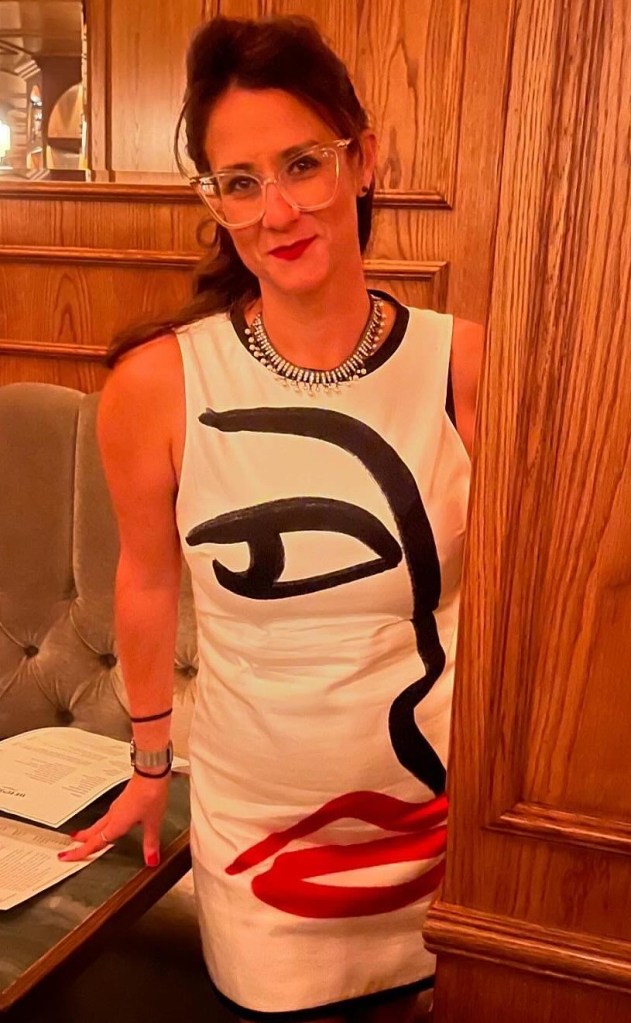
Valerie Giovanini, Ph.D.
Valerie has always used her classrooms with learners of philosophy to engage meaningful questions in creative ways. Philosophy is a way of life and state of mind that constantly seeks to question, critique, overturn, and re-evaluate what is taken as true. The aesthetic space of unlearning to generate a creative imagination is a resource that was always used in her classrooms to pump intuition and pull on meaningful threads in the lives that Valerie encounters. Art-care facilitation along with Spontaneous Creation Making provide strategies and methods to develop what is most meaningful in these encounters, which is to hold a vulnerable but also safe space for genuine self-reflection, expression, and co-creation.
In addition to classroom activities, in 2024 Valerie took Art-care to the Nordic Summer University’s meeting in Denmark to facilitate an encounter through free-writing with radical trust between a circle of feminist women to the concerns in women’s secret voices dating back to the 1700s. She has also published Tikkun Olam: Book Review for Art-Care Practices for Restoring the Communal (Bickel & Fisher, 2023), and on her use of Art-care in Teaching Philosophy as a Pedagogic Practice-ing, both of which appear in Artizein: Arts and Teaching Journal (2023, v.8.1.). Most recently, she used Bracha L. Ettinger’s Matrixial Theory to create an imaginary Art-care borderspace as a transport-station of healing from the traumas of war in A Matrixial Museum: Education in Almost-impossible Spaces and anticipates future Art-care projects in relation to this conflict.
Art-Care Facilitator Level 2 Certificate holder.
academia.edu/ValerieGiovanini

Hallie Sanclemente Morrison
After the first pandemic-response Restoration Lab series with Studio M*, Hallie Sanclemente Morrison continued to facilitate and offer Spontaneous Creation-Making (SCM) gatherings virtually and in-person from 2020-2022. Meeting regularly to communally experience Spontaneous Creation Making felt incredibly healing for Hallie and others, and it helped continue the positive ripple effect of cultivating respective, satellite sanctuary spaces for the growing SCM network. Hallie found great personal growth in aspects of self-trust and optimism through creative “wit(h)nessing” (Ettinger) and creating safe spaces through SCM–despite the immense, ongoing, collective feeling of fear induced by the pandemic and colonial oppression. Hallie continues to offer SCM one-on-one with close friends, and implements elements of SCM in their community organizing with Indigenous communities throughout the US. She has served as Studio M*’s program & media advisor.
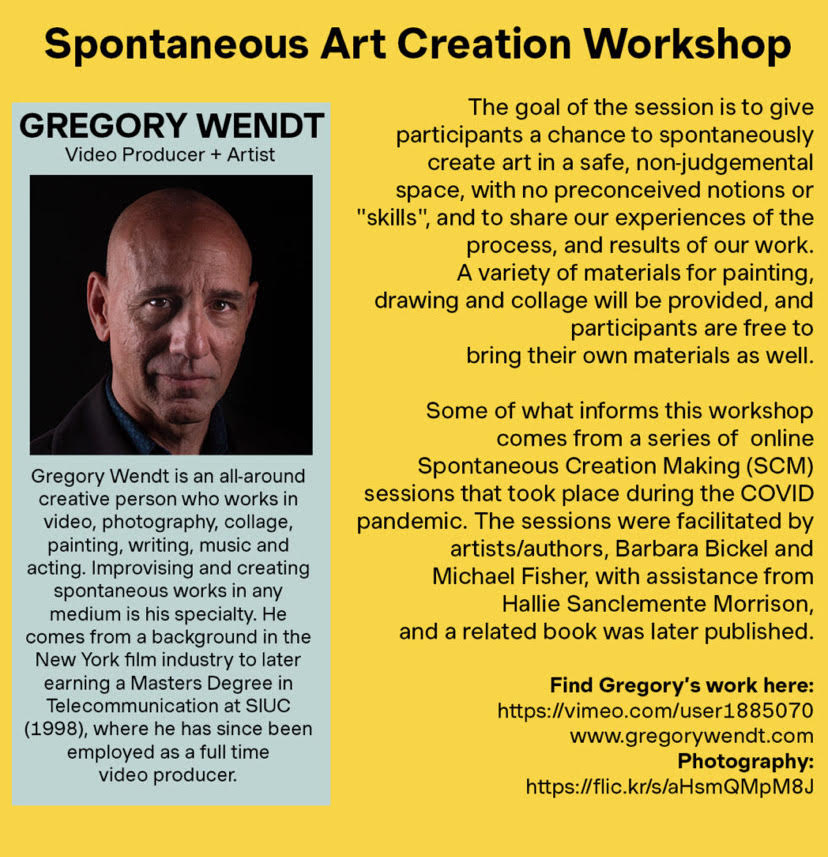
Gregory Wendt
Improvising and creating spontaneous works in any medium is Gregory’s specialty. The goal of Gregory’s Spontaneous Creation-Making workshops is to give participants a chance to spontaneously create in a safe, non-judgmental space, with no preconceived notions or “skills,” and to share their experiences of the process and results of their work. A variety of materials for painting, drawing, and collage are provided, and participants are free to bring their own materials as well.

Adrienne Adams
Since her experiences with SCM, Adrienne Adams has informally incorporated some of the practice into how she keeps in touch with her friends–one friend in particular, with whom they meet over Zoom weekly. Spontaneously and occasionally, she will invite her other creative friends to join on a group Zoom. The main goals are to keep in touch with each other as friends, connect, and support and appreciate each other’s creative practices. The main thing that is done every time, is the of lighting a candle together at the beginning and end of each session, pulling cards, and or using bibliomancy to reflect on life and provide a lens to share with each other and co-creation. Sometimes, this takes the form of doing art alongside each other while visiting, and then each sharing and appreciating what the other has done; sometimes, this involves cooking together; sometimes, one is focused on painting rocks and the other on sorting seeds. The main point is connection, support, and appreciation of each other and each other’s creativity. Sometimes, eating together is involved. This is a fun and supportive way to stay in touch and ensure we are all creating on a regular basis. It is very nurturing and mutually beneficial. Adrienne appreciates her time and study with more formal SCM groups, and how these practices then inform her online friendships, connections, and creativity in many ways.

Kate Wurtzel & Laura Lee McCartney
As a way to begin taking art-care into their communities, Dr. Laura Lee McCartney and Dr. Kate Wurtzel collaborated with two of their pre-service art education classes and engaged in Spontaneous Creation-Making sessions over the course of one semester. During that semester, students met and created art over Zoom four times, where they were provided with specific art making materials and open-ended Spontaneous Creation Making prompts. The evolving artworks from the Zoom sessions were then passed between Texas and North Carolina several times and modified from student to student, making the final outcome surprising and unpredictable. Students were invited to reflect on the monthly SCM experiences and shared narratives about the importance of protecting time and space to be artist-educators in their practice. Students also envisioned ways to incorporate SCM tools and maps into their future teaching with K-12 students.
 Studio M*