
R. Michael Fisher & Barbara Bickel with Wendalyn Bartley, Adrienne Adams,
Janet Sheppard, Valerie Giovanini, Marc Brudzinski & carol weaver
In the late summer-fall of 2025, a small art-care centred study with nine participants took place with a focus on animism and how it enhances a creation-centred literacy within Spontaneous Creation-Making (SCM). From past studies and facilitating, Barbara and Michael have found that making creations often comes more easily than responding to creations, in part, due to conditioned habits and lack of confidence when responding to art/creations. A central part of SCM is the group sharing of the creations which we frame as the continuation of creation itself. Sharing includes and moves beyond experience, expression, or stories and emphasizes the unarticulated and the mystical and magical. One of the aims of this study was to give more time for responding, as enhanced by animistic prompts. Within the study, with its focus on animism, sharing and responding has transformed within a deeper post-humanist understanding of SCM and creation itself.
Spontaneous Creation-Making is a practice that is taught and continues to be developed through Studio M*. SCM operates within a relational aesthetic praxis (i.e., theory + practice) situated within compassionate humanist and post-humanist relational ontologies of co-inquiry and creation-centred living literacies (e.g., Bickel & Fisher, 1992, 2023; St. Georges & Bickel, 2022). Artworks are considered more-than-human, with Creation itself at the center of a group practicing SCM. The sharing and wit(h)nessing (a la Ettinger, in Boscacci, 2018) of the creations made, are dynamic, dialectical, healing and magical at times—informing a living-birthing-centered literacy via artworking (Ettinger, 2006).
In studying the three SCM Happenings and two post-reflective sessions, it became evident that co-inquirers gained a new regard for the importance of animism in art-making, creation-sharing and creation-responding. It is hypothesized that evolving an animistic sensibility in SCM enhances the spirit of a gifting economy (Vaughan, 1997) within the practice and its after-effects. Including animistic quotes and prompts in the SCM sessions helped to create an animistic group consciousness and expanded imaginary literacies, which enlivened an experience of “spontaneous community.”
Defining Animism
More than focusing on ‘what is animism’ this study and inquiry was directed to the spontaneous creation-making habitat or ecology for what would be possible for enhanced imaginaries, vocabularies and literacies of an animistic consciousness and sensibility. We focused on the aesthetic-affective-creative relational dimension more than a religious dimension; yet, consistent with traditions of studies of animism across other disciplines, we accepted a soft-loosely-held idea that “Animism is a particular sensibility and way of relating to various [seen and unseen] beings in the world. It involves attributing sentience to other beings [elemental forces, materials and places]” (Swancutt, 2019, p. 1). carol weaver (2025), one of the co-inquirers offered an ethical piece of writing on animism;
I feel we have lost our connection and right relationship to Mother earth, nature and all Her living beings—for we wouldn’t be here without Her….We wouldn’t be here on our Mother without the sacred elements of air, fire, water and earth. Without the living and breathing trees, we as humans could not breathe… which is a sacred ‘right’ relationship. Animism emphasizes respect for all living things and the interconnectedness of life. (pers. comm. Oct. 14, 2025)
weaver captures the Big Sharing that is fundamental to Creation itself, and in that sense creation-informed art-making is always a sharing, “the artist can’t not-share with an-other, she can’t not witness the other” (2005, p. 704) says Ettinger. What is more difficult for modern humans is to attune to sharing as the foundation of existence, which puts a feminine-centered, matrixial aesthetic and ethical spin on being—being human, and more-than-human. SCM has always been situated onto-epistemologically as a circle of sharing more than anything else.
This blog includes transcript excerpts from the co-inquiry sessions and more of our discoveries. In particular, with a focus on how animism alters and brings greater awareness to how we respond to and be with creations in the SCM sharing circles.
[T]he most forceful aspects of language occur in the gestures, the pauses, the tones and rhythms, not in the meanings of Words. People speaking different languages can use such things to communicate in some of the most important ways. They can convey ideas about love, food, danger, humor, anger, or curiosity. Thus, in spite of the power of Words, there exists a more significant and universal form of communication that does not require Words. (Jacobs, 1998, p. 210)
SCM is a form of communication that is not limited to Words and opens portals leading to entangled layers of human and greater-than-human communications. This is core to animistic practices.
Before you read further, we invite you to engage with a SCM Grounding led by Michael:
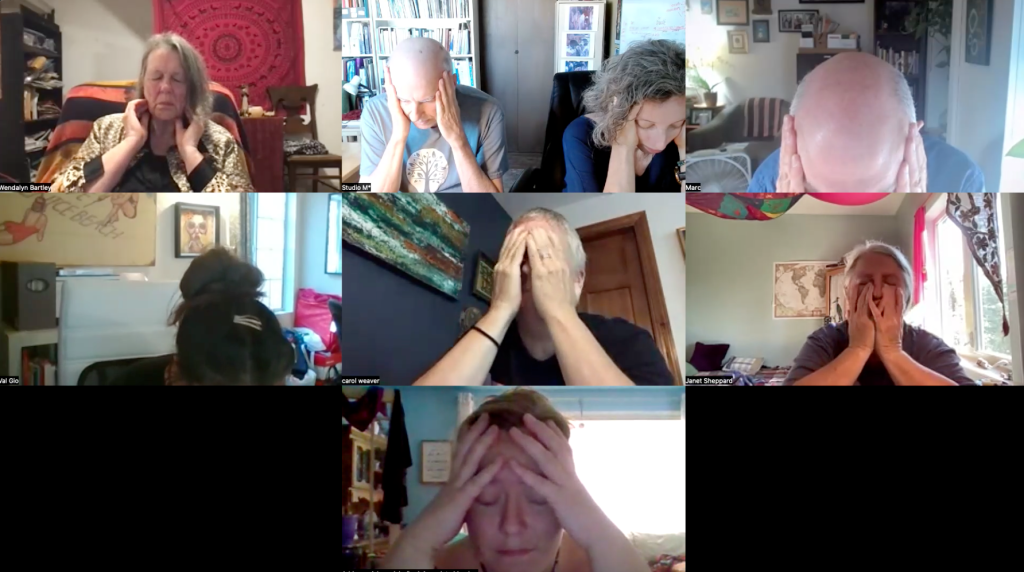
[Video Still of the Sound Grounding, SCM session 2, Sept 4, 2025]
If you are at your desk, lean forward and grasp your skull, realizing that you are touching your bones, feel those bones, that are a vibratory sounding board. Take a few deep breaths, touching the sounding board of your skull bones make some sounds. Take a few moments to make some human contemporary sounds, whatever you want, improv…. Next make early hominid sounds, going back a few million years… now, go back hundreds of millions of years to ancestral primate sounds…. Then go back as far as you want in the evolutionary spectrum and make the most primal sounds you can [for 10-15 seconds] – and now come back into your body in present time.
We focus this blog on the group’s responding to Wendalyn’s sound creation that was accompanied by looking at a shared video-still on the computer screen.
Listen to the recording:
Responses (Wit(h)nessing)
Barbara: It felt like a sound gathering, like everything that’s been shared. The scratches
Michael: The vibrating bones [hands on his head] from our head sounds [from the opening grounding] our hands, all those lines, a swirl
Barbara: And the depth of voice, it felt like a real grounding with the depth of voice
Michael: Chorus of the corn
Valerie: Crows cawing with trans-looping, wind whooshing, was there a river running?
Wendalyn: It was light water dropping… moisture in the air and it was just lightly dripping. But the mic really picks up on it, so amplifies it
Adrienne: Took us back to the beginning. And the crows are like a modern sound and the voice is like the hominid, the ancient, then the resonance, it’s like all the ancient sounds coming up through the skull and they all come together. Like Barbara said, so there’s the circle from the beginning, it’s beautiful ancient and gorgeous and had those nails scraping the sound of the corn in it too, the surface of the cosmos
Wendalyn: The cornfield has nothing to do with it
[all laughing]
Michael: Maybe so, but it’s a great visual to go with it…we saw the visual of the corn field
Wendalyn: It’s the same land, but the visual was from summer time. I was there recently. I just did the sounding a few weeks ago. The other audio was done in winter at Christmas
Valerie: It was very elemental, it felt like all the elements were engaged and the corn and the food and sustenance was a perfect visual as we were being nourished in the sounds and the water and the crows, oh, my goodness, oh my gosh. Talk about the jibber, the jabber and the peckings and the scratching on the board. I mean it’s all rhythm. I don’t know about the sentimental of it, Janet, but if anything is going to be, what did you say [in your earlier sharing], “Love isn’t the answer to the failed experiment, that we’ve become” and I agree. Love and the sentimental, no way. But this cooing and cawing, the crows that we all can elementally relate to and be nourished by. Maybe that’s the salve or the balm at least in this fucking war-torn garbage of a nest that we are destroying.
Michael: It keeps the weaving…
Adrienne: [speaking to Jan in her zoom room] I just see the herons behind you [like the herons Adrienne shared a story about earlier]. I just love the circle communion of us all. And everyone and every being and everything. Yeah
Barbara: I wasn’t seeing a video but I was envisioning in my mind’s eye all the different pieces that have been shared by each one of us today. It was a sound track for all the creations that we’ve taken in tonight, so thank you. Thank you all for that weaving
Michael: Any last words, as we close the circle, rememberings?
Valerie: Gratitude
Adrienne: So much gratitude
Michael: Send that all out to the world, the cosmos…
weaver: [hands in namaste]
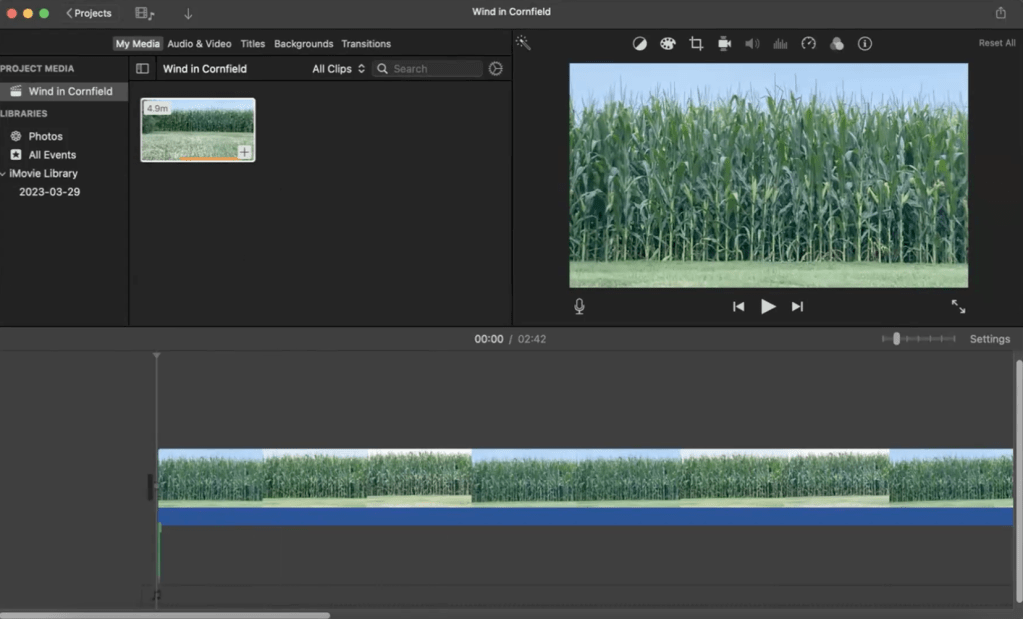
Image of the screen share we were looking at while listening to Wendalyn’s soundtrack, SCM session 2, Sept. 4, 2025.
Afterthoughts
In the dialogical spontaneous responding/sharing, the circle is obviously flowing together, weaving experiences. Responses move into poetics and overlapping threads that come from other responses asynchronous to Wendalyn’s sharing. This combining is an exciting part of creation-centred cascading effects and affects, of which people, art images and materials exchange through fluid bodies and valuations of art-care for all. Animistic aspects in these experimental sessions of the study appeared many times, in diverse ways. With examples such as: “Talk about the jibber, the jabber and the peckings and the scratching on the board. I mean it’s all rhythm” and “I just love the circle communion of us all. And everyone and every being and everything” and “Chorus of the corn.”
Such responses demonstrate entering of borderspaces, crossing time, place, space with bodies and literacies of diverse beingness co-becoming. By the end of this co-encounter, matrixially-speaking, gratitude for the sharing experience reflects a sense of oneness, a jointness-in-difference (a la Ettinger in Pollock, 2020, pp. 2-5) through sensitivity and creativity, a spontaneity and gifting potency is derived. Adrienne shares, “I just love the circle communion of us all” and our research has shown that most all people in the SCM process, in different ways, utter similar words and/or sentiments during the sessions.
What remains of interest, in the animistic sense of co-inquiry, is the question of how creations themselves are experiencing the circle of sharing/community? We can attend to this proposition and expect answers yet to be/come and yet to learn from. This small study magnified the presence of being/ness as “shareability” in SCM and how awareness of animistic presences expand human ability to respond in-fullness-across diverse realms. Responding with awareness calls us to deeply listen to the wisdom of all teachers that come in many forms. It also, in practice and theory, moves us towards a verdant landscape of sharing and gifting which is the very heart of Creation.
In the Matrix, the emergence of meaning is not directly related to absence or even to the rhythmic movement of presence and absence of the object, but to the subjective retuning in shareability. (Ettinger, 2020, p. 281)
Note: In late 2026 a chapter will be published in a book entitled “Creation-Centred Living Literacies: Turning Points and Truth Telling” co-edited by Drs. Darlene St. Georges & Stephanie Bartlett. The chapter will present several examples of co-inquirers’ creations made in their individual home space, and shared with the group resulting in a plethora of wild and spontaneous responses that indicated transformations and new learnings/birthings.
References
Bickel, Barbara, & Fisher, R. Michael. (2023). Art-care practices for restoring the communal: Education, co-inquiry and healing. Routledge.
Bickel, Barbara, & Fisher, R. Michael. (1992). Opening doors: A guide to spontaneous creation-making. In Search of Fearlessness Research Institute.
Boscacci, Louise. (2018). Wit(h)nessing. Environmental Humanities, 10(1), 343-47.
Ettinger, Bracha L. (2020). The Matrixial gaze and screen other than phallic and beyond the late Lacan [1995/1999] (pp. 246-285). In G. Pollock (Ed.), Matrixial subjectivity, aesthetics, ethics (Vol. 1), 1990-2000. Palgrave.
Ettinger, Bracha L. (2006). The matrixial borderspace. University of Minnesota Press.
Ettinger, Bracha L. (2005). Copoiesis. Ephemera: Theory and Politics in Organization, 5 (X), 703–13. http://www.ephemerajournal.org/sites/default/files/5-Xettinger.pdf
Jacobs, D. T. (1998). Primal awareness: A true story of survival, transformation, and awakening with the Rarámuri shamans of Mexico. Inner Traditions.
Pollock, G. (2020). Introduction: Matrix as a sensing-thinking apparatus. In B. L. Ettinger, Matrixial subjectivity, aesthetics, ethics (Vol. 1) (pp. 1-98). Palgrave Macmillan.
St. Georges, Darlene. & Bickel, Barbara. (2022). An inspirited artistic co-inquiry with raw energy. Art/Research International: A Transdisciplinary Journal, 7(1), pp. 210-256.
Swancutt, Katherine. (2019). Animism. In F. Stein, S. Lazar, M. Candea, H. Diemberger, J.
Robbins, A. Sanchez & R. Stasch (Eds.), The Cambridge encyclopedia of anthropology.
http://doi.org/10.29165/19anim
Vaughan, Genevieve. (1997). For-giving: A feminist criticism of exchange. Plain View Press in collaboration with the Foundation for a Compassionate Society. http://gift-economy.com/wordpress/wp-content/uploads/2016/07/forgiving_english_rev2016.pdf
 Studio M*